Claude Design: The Figma Alternative That Ships to Canva in 2026
Claude Design launched as the real AI alternative to Figma: prompts, mockups, direct export to Canva. Who it's for, why it matters, and how to use it.
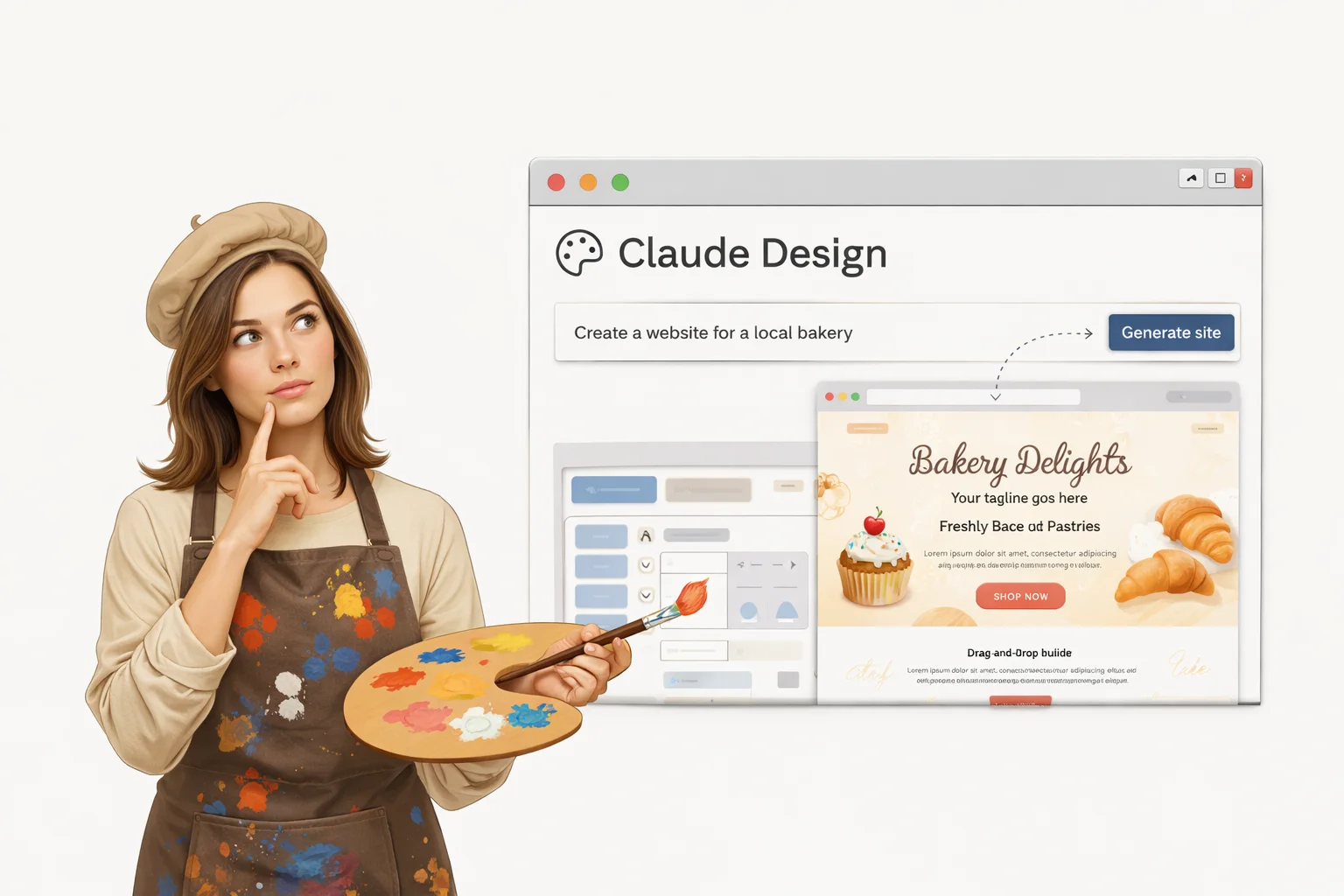
On April 17, 2026, Anthropic shipped Claude Design, and within a few hours I could see what was about to change for every person who has ever tried to open Figma and closed the tab three minutes later. Solo founders without a designer, marketers improvising on Canva, product managers sketching ideas on paper, you can breathe.
Let me walk you through exactly what it changes, who it's for, and why it has nothing in common with what came before.
Claude Design is Anthropic's design tool, powered by Claude Opus 4.7, available at claude.ai/design for anyone on Claude Pro, Max, Team, or Enterprise. You describe what you want, drop a document or a piece of your website, and Claude hands you a first version in seconds. Not a shaky draft, an actual mockup.
What Claude Design actually does
You open the interface, describe your need in plain language, and Claude builds a first proposal. You can start from a pure prompt, a Word doc, a PowerPoint, an Excel sheet, your codebase, or a direct capture of your website so the prototype looks like the real product. Once the mockup exists, you edit it live: inline comments on a specific element, direct text editing, small knobs to adjust spacing, colors, layout.
One stat that Anthropic highlighted: the edtech company Brilliant, which tested the product early, benchmarked its most complex pages. In competing tools, recreating them took more than 20 prompts. Inside Claude Design, it took 2. That kind of gap changes the nature of the work, not just its speed.
Claude Design is the moment when the mockup stops being a bottleneck. You shape an idea in the morning, you show it by the end of the day, and it already looks like the final product.
Who it changes things for
I think first of solo founders. The ones carrying an idea, who need to pitch it to investors or to their first users, and who have neither the time nor the budget to hire a designer. Before, you muddled through Canva with templates that betrayed your inexperience. Now, you describe your product, Claude Design gives you a clean prototype, and you can show your vision without apologizing.
I also think of marketers who ship ten visuals a week, of product managers who need to communicate an idea without mobilizing a designer, of account executives preparing a client deck at the last minute. All of them share the same problem: the distance between the idea they have in their head and the visual they can produce on their own is too wide.
That said, be honest with yourself. If you're a senior designer, if you work in a mature product team that iterates pixel by pixel with complex auto-layouts, Figma remains your tool. Claude Design doesn't replace the refined work of a designer who knows the craft. It replaces the absence of a designer when you don't have one.
The real edge, staying inside the Claude ecosystem
This is the part other Claude Design reviews never push hard enough. During onboarding, Claude reads your codebase and your design files to build your design system. It learns your colors, your typography, your components, and it applies them automatically to every new project. You stop having to restate your brand on every iteration.
And above all, you can hand your mockup directly to Claude Code to turn it into a working project. No PDF export for a dev to reinterpret, no lossy translation between a Figma file and a React component. Claude Code opens the same context, understands the mockup's intent, and codes the product.
This is the first time an idea can travel from your head to a prototype, then from a prototype to production, without switching tools and without losing a single piece of information along the way. That continuity is the real productivity lever. Not the fast generation, the continuity.
Claude Design against Figma and Canva
Figma stays king when ten designers need to collaborate on a pixel-perfect system, with variants, branches, shared tokens. That ground isn't being attacked. Anthropic isn't trying to replace it, and the market half-understood it: Figma stock dropped 5% on launch day, not 50%.
Canva sits at the opposite end. You finalize brand content, push out an Instagram carousel, a banner, a template for your comms team. And that's exactly where Anthropic played smart: the partnership with Canva, already active for two years, is becoming a product-level integration. You generate your mockup in Claude Design, you send it to Canva in one click, and you find your assets editable inside Canva's Design Engine for finishing and publishing.
Claude Design takes the middle seat, the one that was missing. Fast ideation through conversation, frictionless iteration, and two possible outputs: into Canva for final brand content, or into Claude Code for a working product. Ideation to refinement. Design to production. You pick your exit lane.
Design isn't the excuse anymore
For years, the sentence I heard most often from founders was "I would have launched, but I don't have a designer". That excuse just lost its meaning. You don't know how to design? Not a problem anymore. You know how to describe what you want? That's enough.